
Last Updated: November 25, 2026
Quick Summary
To buy high purity peptides for lab work, verify independent, batch-specific testing before you commit. Confirm the purity specification, request the certificate of analysis for that specific lot number, and check that the data came from an independent laboratory. High purity peptides are compounds whose identity and purity have been confirmed by analytical testing, typically HPLC and mass spectrometry, at a stated specification for a given batch.
Buying high purity peptides for lab work means verifying independent, batch-specific testing before you commit. Confirm the purity specification, request the certificate of analysis for that specific lot number, and check that the data came from an independent laboratory.
High purity peptides are compounds whose identity and purity have been confirmed by analytical testing, typically HPLC and mass spectrometry, at a stated specification for a given batch.
| Check | What to look for | Why it matters |
|---|---|---|
| Purity specification | Stated method and percentage | Confirms the claim is testable |
| Lot number | Matches your vial exactly | Ties data to your batch |
| Testing laboratory | Named independent lab | Removes self-reporting bias |
A peptide certificate of analysis is only useful if it belongs to your batch. Match the lot number to the vial you are ordering; a document with a different lot, or no lot, is marketing material rather than data. Look for HPLC with a named detection wavelength and mass spectrometry for identity; our guide on how to read a peptide certificate of analysis breaks down each section.
Peptide purity testing methods fall into two groups: separation methods that measure how much of the sample is the target compound, and identity methods that confirm the compound matches the label. You need both, per batch.
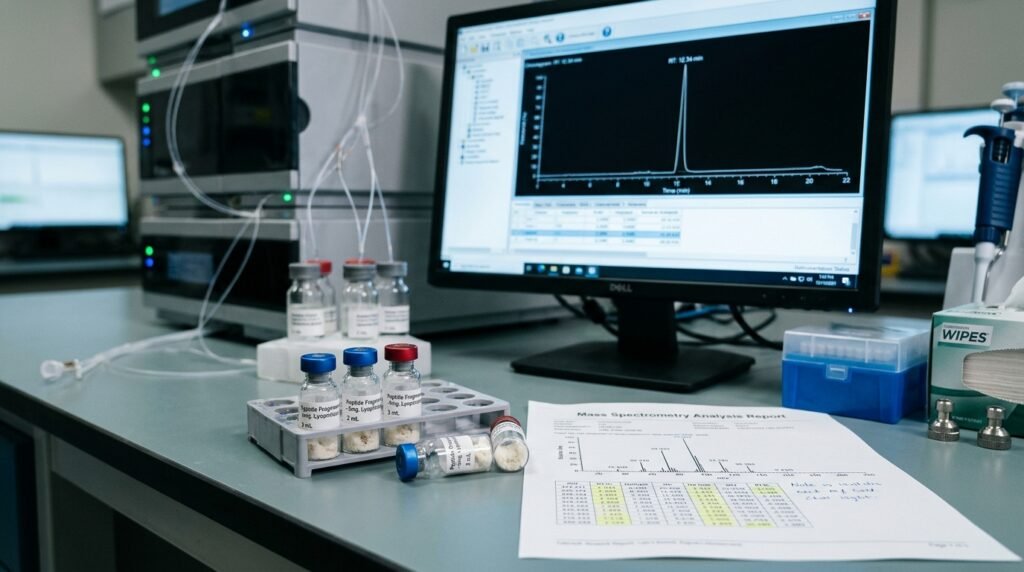
HPLC separates sample components and reports the target peak as a percentage of total peak area. Mass spectrometry measures molecular mass, confirming identity and flagging sequence deletions or modifications. Run together as HPLC/MS, they give purity and identity from the same lot.

Third-party testing matters because self-reported results carry a conflict of interest. Ask whether reports are batch-specific and whether raw chromatograms and spectra are available. For a concrete example, review the BPC-157 10 mg research vial listing and its documentation. (Source: Health Canada’s chemical safety protocols)
| Method | What it proves | What it misses |
|---|---|---|
| HPLC | Purity percentage by peak area | Does not confirm identity alone |
| Mass spectrometry | Molecular identity and mass | Does not quantify purity alone |
| HPLC/MS combined | Purity plus identity, same lot | Requires a competent independent lab |
Vetting research peptide suppliers comes down to documentation you can check and answers you can get in writing: purity specification with method, batch-specific certificate of analysis with lot number, mass spectrometry identity confirmation, a named independent testing laboratory, raw chromatograms on request, clear storage and shipping conditions, and a written out-of-spec process. Ready to compare compounds? Browse the high purity peptide range.
Peptide storage and handling affect reproducibility as much as synthesis does. Store lyophilized vials sealed and dry at the supplier-specified temperature; aliquot reconstituted material instead of refreezing the whole stock; keep working solutions cold and protected from light; record reconstitution date and solvent on the label. Ask how the supplier packs and ships, and inspect packaging on arrival. Ask suppliers about their dispatch times so time out of controlled storage stays short.
Sourcing research compounds should not feel like a gamble on paperwork. StratagenLab tests every compound independently before it ships, publishes batch-specific documentation, and ships the same day so your equipment does not sit idle. Browse the catalog to compare available compounds, or contact our technical team with method questions before you order.
The appropriate purity threshold depends on the assay and should be set by the researcher’s protocol. The right threshold depends on your application: cell culture and receptor studies usually need tighter specifications than preliminary screening. Ask for the batch-specific purity figure from HPLC analysis rather than a general marketing claim, and confirm the method used to calculate it. Ask StratagenLab for the independent third-party results for the lot you are considering so you can match the specification to your protocol before ordering.
A credible peptide certificate of analysis should list the lot number, the testing laboratory, the analytical methods used, and the actual chromatogram and mass spectrometry data, not just a pass or fail line. Cross-check that the lot number on the COA matches the vial you receive. Where possible, confirm the report came from an independent lab rather than the supplier’s own bench. If a supplier cannot produce batch-specific raw data on request, treat the documentation as incomplete and look elsewhere.
No. Research-grade peptides are intended strictly for in-vitro laboratory research and are not for human or veterinary use. They are not approved therapeutics, and their safety and efficacy in humans have not been established through clinical trials. Researchers should follow their institution’s biosafety and chemical handling policies, keep compounds labeled as research reagents, and dispose of them according to local laboratory waste requirements.