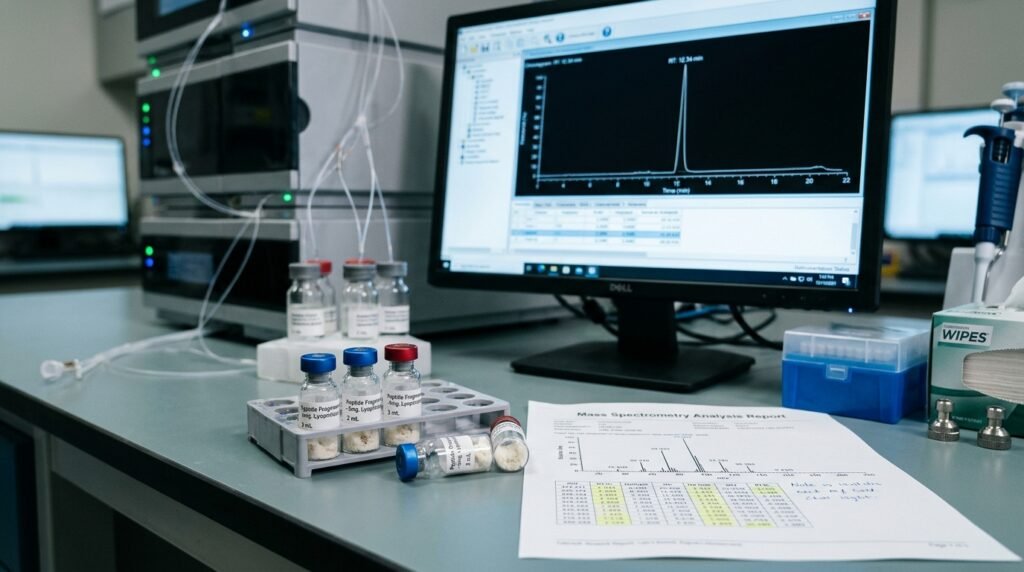

In laboratory and biochemical research, experimental reproducibility hinges upon the purity and identity of test compounds. Contaminated, degraded, or inaccurately synthesized peptides introduce confounding variables that invalidate experimental datasets and waste valuable laboratory resources.
A legitimate Certificate of Analysis (COA) is the primary technical document verifying that a batch of lyophilized peptide meets verified specifications for identity, purity, and quantity. This guide breaks down the core analytical components of an authentic peptide COA.
Every comprehensive peptide COA must provide three independent analytical verifications:
High-Performance Liquid Chromatography (RP-HPLC) is the analytical standard for determining peptide purity. It separates compounds based on hydrophobicity as they pass through a stationary column under high pressure.
Absorbance (mAU)
   ^
   │             [ Main Target Peak: 99.2% Area ]
   │                     │
   │                    / \
   │                   /   \
   │                  /     \
   │      [Minor     /       \
   │      Impurity] /         \
   │         /\    /           \
───┴─────────┴────┴─────────────┴─────────────────► Retention Time (min)
$$\text{Purity (\%)} = \frac{\text{Area of Target Peak}}{\sum \text{Total Peak Areas}} \times 100$$
Research-grade peptides for rigorous in-vitro applications should reliably demonstrate $\ge 98\%$ or $\ge 99\%$ purity by HPLC.
While HPLC confirms how pure a sample is, it cannot confirm what the molecule actually is. A molecule with an entirely incorrect sequence could yield a clean, sharp peak on HPLC.
Electrospray Ionization Mass Spectrometry (ESI-MS) or MALDI-TOF verifies chemical identity by measuring the exact mass-to-charge ratio ($m/z$).
| Analyte | Formula | Theoretical Mass (Mw) | Observed Mass (m/z) | Pass/Fail |
| BPC-157 | $\text{C}_{62}\text{H}_{98}\text{N}_{16}\text{O}_{22}$ | 1419.53 Da | 1419.60 Da | PASS |
| GHK-Cu | $\text{C}_{14}\text{H}_{22}\text{N}_{6}\text{O}_{4}\text{Cu}$ | 403.92 Da | 404.10 Da | PASS |
A frequent point of confusion in laboratory preparation is the distinction between Gross Lyophilized Mass and Net Peptide Content:
High-level analytical reports include Amino Acid Analysis (AAA) or elemental analysis to state exact peptide content, allowing precise molar dilution calculations for quantitative assays.
At StratagenLab, every batch undergoes rigorous independent third-party analytical verification with published HPLC and Mass Spectrometry documentation to ensure scientific inquiry remains reproducible and dependable.
Disclaimer: Strictly for scientific and laboratory educational purposes. All products are intended solely for in-vitro research use.


Augue Sed viverra nulla Interdum mia bibendum velit sapien usop scelerisqu ictum quam tincidunt nec feugiat augue tincidunt Etiam pretium diam rhoncus. gida turpis cursus. Nuncsed fringilla tortor iaculis eget tincidunt accumsan ullamcorper.