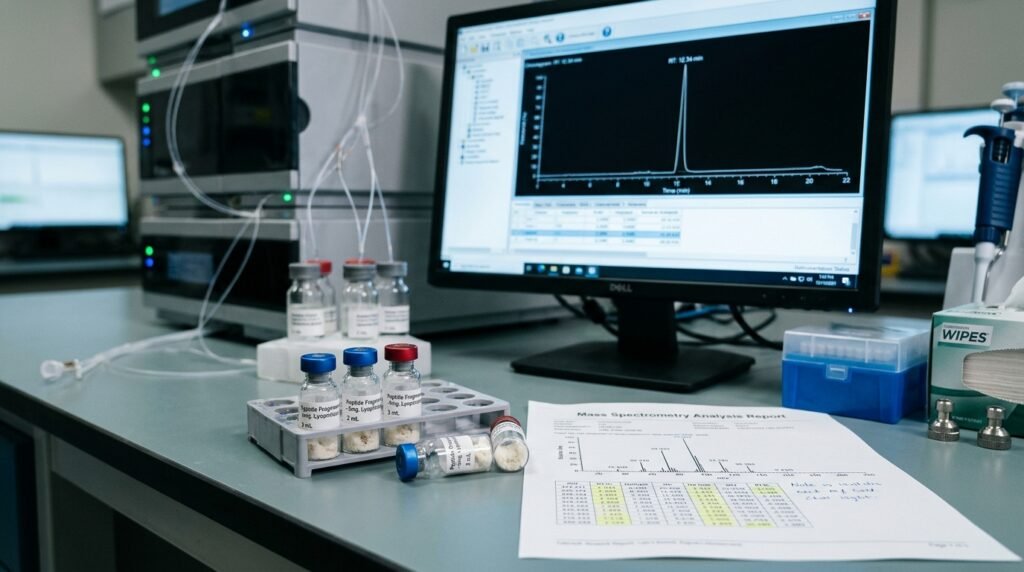

Originally isolated from human plasma by Dr. Loren Pickart in 1973, glycyl-L-histidyl-L-lysine (GHK) possesses a natural, high-affinity binding complex for copper(II) ions ($Cu^{2+}$), forming the biologically active tripeptide complex GHK-Cu.
Over five decades of biochemical research, GHK-Cu has emerged as one of the most extensively studied matrikines—peptides capable of orchestrating gene expression, extracellular matrix (ECM) turnover, and structural protein synthesis in connective tissue research.
The structural potency of GHK-Cu lies in its tripeptide sequence, which mimics natural degradation fragments of collagen:
$$\text{Gly-His-Lys} : \text{Cu}^{2+}$$
The histidine imidazole ring, the glycine amino terminus, and the lysine amide nitrogen form a square-planar coordination sphere around the $Cu^{2+}$ ion. This complex delivers trace copper directly to intracellular enzyme binding sites that depend on copper cofactors.
                      [ GHK Tripeptide ]
                              │
                    Cheated Cu2+ Complex
                              │
         ┌────────────────────┼────────────────────┐
         ▼                    ▼                    ▼
Lysyl Oxidase (LOX)   Transforming Growth    Matrix Metalloproteinases
  Cross-linking        Factor-beta (TGF-β)      (MMPs & TIMPs)
(Fibril Maturation)   (Collagen I & III)       (Regulated Remodeling)
Unlike agents that induce unregulated fibrotic scarring, GHK-Cu acts as a bidirectional modulator of the extracellular matrix:
In cultured human dermal fibroblasts, GHK-Cu significantly enhances the transcription of:
Tissue remodeling requires both synthesis and organized degradation of damaged scaffolding. GHK-Cu modulates:
Broad gene profiling studies demonstrate that GHK-Cu shifts cellular expression profiles toward youthful states:
In experimental designs evaluating regenerative tissue models, distinguishing between hydrolyzed collagen substrates and bioactive copper complexes is vital:
| Parameter | GHK-Cu Tripeptide Complex | Hydrolyzed Collagen Peptides |
| Primary Role | Epigenetic signaling & enzyme activation | Structural amino acid supply (substrate) |
| Active Concentration | Nanomolar range (1–10 nM) | Micromolar to millimolar range |
| Enzyme Activation | Directly activates Lysyl Oxidase & SOD | Does not donate copper cofactors |
| MMP Regulation | Actively balances MMP / TIMP expression | Passive presence in cellular media |
GHK-Cu produces a distinctive, unmistakable vibrant blue to cyan coloration in aqueous solution due to the coordination geometry of the $Cu^{2+}$ ion:
Disclaimer: Strictly for laboratory and in-vitro experimental research. Not for human or therapeutic use.

Augue Sed viverra nulla Interdum mia bibendum velit sapien usop scelerisqu ictum quam tincidunt nec feugiat augue tincidunt Etiam pretium diam rhoncus. gida turpis cursus. Nuncsed fringilla tortor iaculis eget tincidunt accumsan ullamcorper.